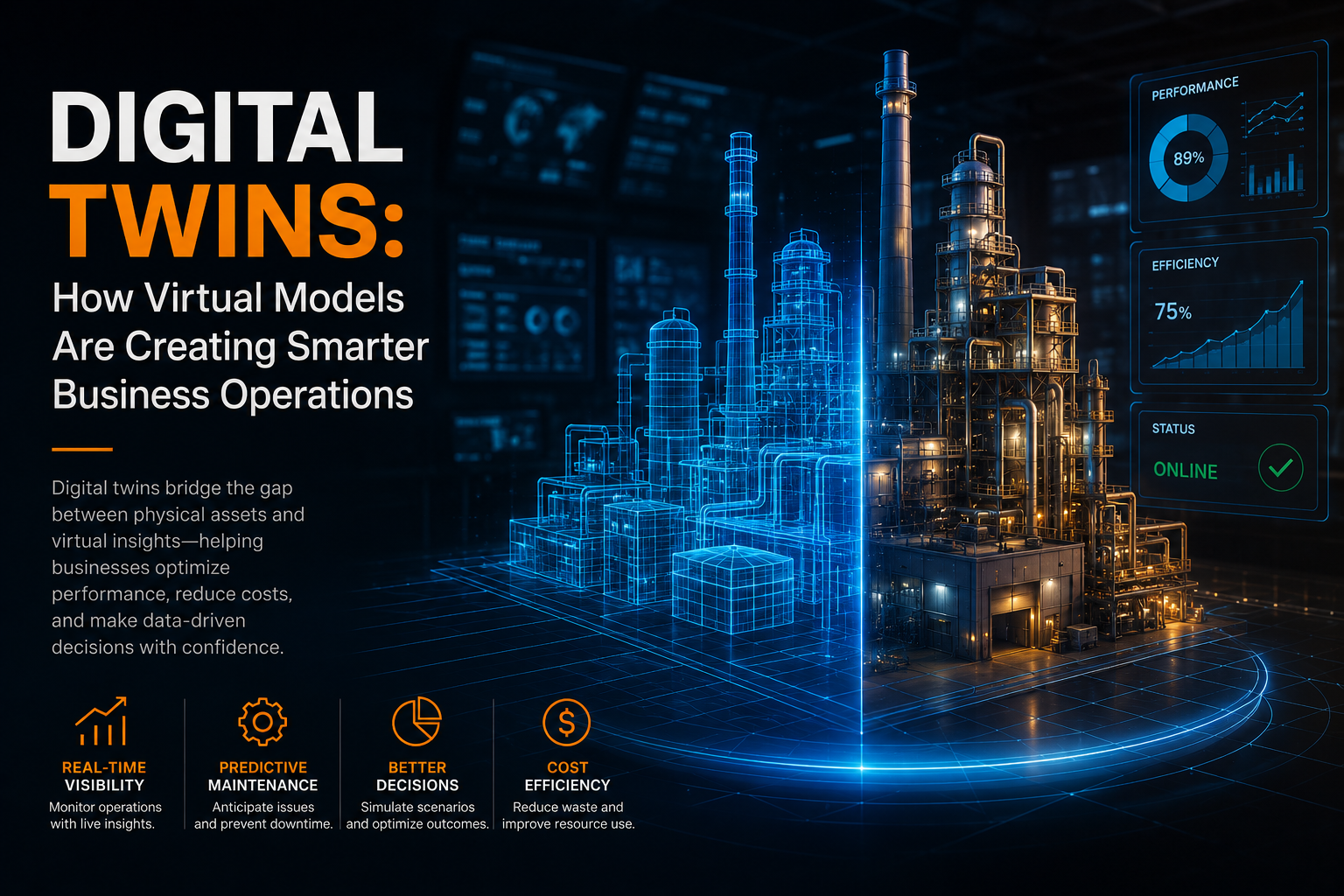
Digital Twins: How Virtual Models Are Creating Smarter Business Operations
Digital Twins: How Virtual Models Are Creating Smarter Business Operations
Businesses across industries are looking for new ways to improve operational efficiency, reduce costs, minimize downtime, and make faster decisions. One technology gaining increasing attention is digital twin technology.
A digital twin is a virtual representation of a physical asset, process, system, or environment. It uses real-world data from sources such as sensors, Internet of Things (IoT) devices, enterprise applications, and operational systems to represent and monitor what is happening in the physical world.
Unlike a traditional digital model, a digital twin can continuously interact with real-world data. This enables businesses to monitor performance, identify potential problems, simulate scenarios, and make better-informed decisions.
Digital twins are increasingly being combined with AI, IoT, cloud computing, analytics, and automation, creating opportunities for organizations to build smarter and more responsive operations.
What Is a Digital Twin?
A digital twin is a dynamic virtual representation of a physical object, process, or system.
For example, a manufacturer could create a digital twin of a production machine.
The physical machine generates information through sensors, including:
- Temperature
- Vibration
- Pressure
- Speed
- Energy consumption
- Operating hours
- That information can be transmitted to the digital twin.
- The virtual model can then provide a real-time representation of the machine's condition.
Businesses can use this information to understand current performance and potentially predict future problems.
Simple Digital Twin Architecture
Physical Asset
↓
Sensors & IoT Devices
↓
Data Collection
↓
Cloud / Edge Infrastructure
↓
Digital Twin
↓
AI & Analytics
↓
Business Decisions / Automated Actions
This combination allows businesses to connect physical operations with digital intelligence.
How Digital Twins Work
Digital twin technology typically involves several interconnected components.
1. Physical Asset
The process starts with a real-world asset or system.
Examples include:
- Manufacturing equipment
- Buildings
- Vehicles
- Wind turbines
- Warehouses
- Energy infrastructure
- Supply chains
2. Sensors and IoT Devices
Sensors collect real-time information from the physical environment.
Depending on the application, sensors may monitor:
- Temperature
- Location
- Pressure
- Movement
- Energy usage
- Humidity
- Vibration
- Performance
3. Data Platform
The collected information needs to be transmitted, stored, processed, and organized.
Cloud and edge computing infrastructure can help businesses process large volumes of operational data.
4. Digital Model
The data feeds into a virtual representation of the physical asset or process.
This creates a continuously updated digital model.
5. Analytics and AI
Advanced analytics and AI can identify patterns and anomalies in the data.
For example, an AI system may identify that a machine's vibration pattern is changing and indicate that maintenance may be required.
6. Business Action
The insights generated by the digital twin can support decisions or trigger automated actions.
This creates a continuous cycle:
Monitor → Analyze → Predict → Optimize → Act
Why Digital Twins Matter for Businesses
Traditional business systems often provide historical information.
Digital twins can provide a more dynamic view of operations.
Instead of asking:
What happened?
Businesses can increasingly ask:
What is happening now?
What is likely to happen next?
What will happen if we change something?
This makes digital twins valuable for organizations that operate complex physical assets and processes.
Key Benefits of Digital Twin Technology
1. Predictive Maintenance
One of the most important applications of digital twins is predictive maintenance.
Traditional maintenance may follow a fixed schedule.
For example:
Inspect machine every six months.
Predictive maintenance instead uses operational data to determine when maintenance may actually be needed.
A digital twin can analyze information such as:
- Temperature
- Vibration
- Operating hours
- Load
- Historical failures
AI and analytics can then identify patterns associated with equipment degradation.
Business Benefits
Predictive maintenance can help organizations:
- Reduce unexpected downtime
- Improve asset reliability
- Optimize maintenance schedules
- Reduce unnecessary maintenance
- Extend equipment lifespan
2. Real-Time Operational Monitoring
Digital twins allow businesses to visualize the current condition of assets and processes.
For example, a logistics company could use digital twins to monitor:
- Vehicle locations
- Delivery routes
- Fuel consumption
- Vehicle health
- Warehouse operations
Managers can use this information to identify operational problems more quickly.
3. Better Decision-Making
Digital twins can provide businesses with a richer understanding of complex systems.
Instead of relying only on historical reports, decision-makers can use real-time information and simulations.
For example, a company planning to increase production can use a digital twin to evaluate whether existing equipment can handle additional demand.
This supports more informed planning.
4. Simulation Without Physical Risk
One of the strongest capabilities of digital twins is simulation.
Businesses can create virtual scenarios before implementing changes in the real world.
For example:
What happens if production increases by 20%?
What happens if a machine operates at higher capacity?
What happens if a warehouse layout changes?
What happens if a supply route is disrupted?
Businesses can analyze these scenarios digitally before making expensive physical changes.
5. Reduced Operational Costs
Digital twins can identify inefficiencies across business operations.
They may help organizations optimize:
- Energy consumption
- Equipment usage
- Maintenance
- Production
- Inventory
- Logistics
- Resource allocation
Even small improvements across large operations can produce significant cost savings.
6. Improved Product Development
Digital twins can also be used during product design and development.
Companies can create virtual versions of products and simulate their behavior before manufacturing physical prototypes.
This can help organizations:
- Test designs
- Identify potential problems
- Reduce physical prototypes
- Accelerate development
- Improve product quality
This approach can be particularly valuable in engineering-intensive industries.
Digital Twins and Artificial Intelligence
Digital twins become even more powerful when combined with AI.
A digital twin provides the data and virtual representation.
AI provides advanced analysis and prediction.
Together, they can create intelligent operational systems.
Example
Consider a manufacturing machine.
The digital twin receives:
- Temperature data
- Vibration data
- Production speed
- Energy consumption
- AI analyzes these signals and identifies a pattern indicating possible equipment degradation.
- The system could then:
- Detect the anomaly.
- Predict a potential failure.
- Estimate when maintenance may be required.
- Notify the maintenance team.
- Schedule maintenance.
- Update the digital twin after repair.
- This creates a more proactive approach to asset management.
Digital Twins and IoT
IoT is one of the key technologies supporting digital twins.
IoT devices provide the real-world data needed to keep digital models updated.
The relationship can be summarized as:
IoT → Data → Digital Twin → Analytics → Action
Without reliable data, a digital twin cannot accurately represent the physical environment.
Businesses therefore need strong IoT infrastructure, connectivity, data management, and security.
Digital Twins and Cloud Computing
Cloud platforms can provide the computing and storage infrastructure required for large-scale digital twin implementations.
Cloud environments can support:
- Data storage
- Analytics
- AI workloads
- Application integration
- Digital twin platforms
- Remote monitoring
- Collaboration
For organizations operating multiple locations, cloud-based digital twins can provide centralized visibility across distributed operations.
Digital Twins and Edge Computing
Not every digital twin workload should be processed entirely in the cloud.
Some industrial applications require extremely fast responses.
Edge computing allows data to be processed closer to the physical asset.
For example:
Machine → Edge Device → AI Analysis → Immediate Alert
Instead of sending every piece of data to a remote cloud environment, critical information can be analyzed locally.
This can reduce latency and support real-time decision-making.
Digital Twin Applications Across Industries
Digital twin technology is not limited to manufacturing.
It can be applied across numerous industries.
Manufacturing
Digital twins can help monitor production equipment, optimize manufacturing processes, and support predictive maintenance.
Common applications:
- Production optimization
- Equipment monitoring
- Quality control
- Predictive maintenance
- Factory simulation
Healthcare
Digital twins can support research, healthcare operations, medical device development, and simulation.
Potential applications include:
- Hospital operations
- Medical equipment monitoring
- Treatment simulation
- Healthcare facility management
Retail
Retail organizations can use digital models to understand physical stores and supply-chain operations.
Applications may include:
- Store layout optimization
- Inventory management
- Customer flow analysis
- Warehouse optimization
Logistics and Transportation
Digital twins can help organizations monitor vehicles, routes, warehouses, and distribution networks.
Applications include:
- Fleet monitoring
- Route optimization
- Predictive maintenance
- Supply-chain simulation
Energy
Energy companies can use digital twins to monitor infrastructure and optimize performance.
Examples include:
- Wind turbines
- Solar farms
- Power infrastructure
- Oil and gas equipment
Construction and Real Estate
Digital twins can help create intelligent representations of buildings and infrastructure.
Applications include:
- Building management
- Energy optimization
- Maintenance
- Construction planning
- Facility monitoring
Digital Twins for Supply Chain Management
Supply chains are complex systems involving suppliers, warehouses, transportation networks, inventory, and customers.
A digital twin can create a virtual representation of the supply chain.
Businesses can then simulate disruptions.
For example:
Supplier Delay → Inventory Impact → Transportation Changes → Customer Delivery Impact
This can help organizations identify potential bottlenecks and evaluate alternative strategies.
Digital twins can therefore support more resilient supply-chain planning.
Digital Twins and Sustainability
Digital twins can also support sustainability initiatives.
Organizations can use digital models to understand resource consumption and identify opportunities for optimization.
For example, a building digital twin could monitor:
- Electricity usage
- Heating
- Cooling
- Occupancy
- Equipment performance
Businesses can use these insights to identify opportunities to reduce unnecessary energy consumption.
Challenges of Implementing Digital Twins
Despite their benefits, digital twins require careful planning.
1. Data Quality
A digital twin depends on reliable data.
Incorrect or incomplete data can produce inaccurate insights.
2. Integration Complexity
Digital twins may need to connect with:
- IoT devices
- ERP systems
- CRM platforms
- Manufacturing systems
- Cloud infrastructure
- Databases
- Analytics platforms
Integration can become complex in organizations with legacy systems.
3. Cybersecurity
Digital twins can provide visibility into important operational systems.
If poorly secured, they may create additional cybersecurity risks.
Businesses should implement:
- Authentication
- Access controls
- Encryption
- Network security
- Monitoring
- Secure APIs
4. Implementation Costs
Building a sophisticated digital twin can require investment in:
- Sensors
- Connectivity
- Software
- Cloud infrastructure
- Data platforms
- AI
- Skilled professionals
Businesses should therefore start with clearly defined use cases.
5. Lack of Technical Expertise
Digital twins require knowledge across multiple technology areas.
Organizations may need expertise in:
- IoT
- Cloud computing
- Data engineering
- AI
- Software development
- Cybersecurity
- Analytics
Working with experienced technology partners can help reduce implementation complexity.
How Businesses Can Implement Digital Twins
Businesses should avoid attempting to build a complete digital twin of their entire organization immediately.
A phased approach is more practical.
Step 1: Identify a High-Value Use Case
Start with a specific business problem.
For example:
Reduce unexpected machine downtime by 20%.
Step 2: Identify Required Data
Determine which information is needed.
This may include:
- Sensor data
- Equipment history
- Maintenance records
- Production data
- Environmental conditions
Step 3: Connect Data Sources
Integrate IoT devices, databases, applications, and operational systems.
Step 4: Build the Digital Model
Create a virtual representation of the selected asset or process.
Step 5: Add Analytics and AI
Use analytics to identify patterns and AI to support prediction and optimization.
Step 6: Connect Insights to Business Workflows
The digital twin should not simply display information.
Its insights should lead to action.
For example:
Predicted Failure → Maintenance Ticket → Technician Assignment → Repair → Performance Verification
Step 7: Measure Results
Track measurable outcomes such as:
- Downtime reduction
- Maintenance costs
- Energy consumption
- Productivity
- Asset utilization
- Production efficiency
The Future of Digital Twin Technology
Digital twins are expected to become increasingly connected with AI, IoT, cloud computing, edge computing, and automation.
Future digital twin environments could become more autonomous.
Instead of simply showing that an asset is experiencing a problem, an intelligent digital twin could potentially:
Detect → Predict → Recommend → Execute → Verify
This could transform digital twins from visualization tools into intelligent operational platforms.
The long-term opportunity is therefore not simply to create virtual models.
It is to create intelligent digital representations that continuously learn from real-world operations and help businesses optimize themselves.
Digital Twins vs Traditional Monitoring
| Capability | Traditional Monitoring | Digital Twin |
|---|---|---|
| Real-time data | Yes | Yes |
| Virtual representation | Limited | Yes |
| Predictive analytics | Limited | Advanced |
| Simulation | Limited | Yes |
| AI integration | Possible | Strong |
| Scenario testing | Limited | Advanced |
| Process optimization | Limited | Advanced |
| Automated decisions | Limited | Possible |
Digital twins provide a broader operational perspective by connecting real-world data with virtual models, analytics, simulation, and decision-making.
Why Businesses Should Start Exploring Digital Twins
Digital transformation is increasingly moving from individual applications toward interconnected intelligent systems.
Businesses that operate physical assets, complex processes, or distributed infrastructure can benefit significantly from digital twin technology.
Organizations should consider exploring digital twins when they need to:
- Reduce equipment downtime
- Improve operational visibility
- Optimize resources
- Predict failures
- Simulate business scenarios
- Improve product development
- Reduce energy consumption
- Strengthen supply-chain resilience
The technology is particularly valuable when small operational improvements can produce significant financial benefits at scale.
Conclusion
Digital twins represent an important evolution in how businesses understand and manage physical operations.
By combining virtual models with real-time data, IoT, AI, cloud computing, edge computing, and analytics, organizations can move from reactive management toward proactive and predictive operations.
The value of digital twins is not simply in creating a digital copy of a physical asset. Their real value lies in connecting data, intelligence, simulation, and action.
As businesses continue their digital transformation journeys, digital twins can become an important foundation for smarter operations, predictive maintenance, better decision-making, and long-term operational efficiency.
Organizations looking to explore digital transformation, intelligent software solutions, AI integration, cloud technologies, or connected business systems can explore Riotech Softwares for technology solutions tailored to modern business requirements.
Frequently Asked Questions
What is a digital twin?
A digital twin is a virtual representation of a physical asset, process, system, or environment that can be connected to real-world data.
How does a digital twin help businesses?
Digital twins can help businesses monitor operations, predict potential problems, optimize processes, simulate scenarios, reduce downtime, and make data-driven decisions.
What technologies are used in digital twins?
Digital twins commonly involve IoT, sensors, cloud computing, edge computing, AI, machine learning, data analytics, APIs, and visualization platforms.
What is an example of a digital twin?
A manufacturing company could create a digital twin of a machine that receives real-time temperature, vibration, energy, and performance data to monitor the machine and identify potential maintenance requirements.
Are digital twins only useful for manufacturing?
No. Digital twins can be applied to healthcare, logistics, transportation, energy, construction, real estate, retail, infrastructure, and other industries.
What is the difference between a digital twin and a digital model?
A traditional digital model may represent a physical object or process without continuously receiving real-world information. A digital twin is generally connected to real-world data and can dynamically reflect the condition or behavior of its physical counterpart.
How can companies start using digital twins?
Companies should begin with a specific, high-value use case, identify the necessary data sources, connect relevant systems, create the virtual model, add analytics or AI, and measure business outcomes.
Are digital twins expensive?
Costs vary depending on the scale and complexity of the implementation. Businesses can reduce risk by starting with a focused use case and expanding after demonstrating measurable value.
What is the future of digital twins?
Digital twins are likely to become increasingly integrated with AI, automation, IoT, cloud, and edge computing, enabling more predictive and potentially autonomous business operations.